
On Max Roach and the Effectiveness of Political Art

This two-part essay begins with notes on a book about the effectiveness of political art, followed by a discussion of Max Roach’s Freedom Now Suite. The book is anchored in a field I know nothing about, contemporary art “interventions,” and I will therefore not be attempting to write a proper review. Instead, these notes focus only on parts that might be relevant to the domain of “political” music. Questions raised in the book are then used to consider Roach’s classic Freedom Now Suite.
New York University professor Stephen Duncombe has written extensively on artistic activism, a term he uses as a synonym for political art, agitprop, socially engaged art, etc. Æffect: The Affect and Effect of Artistic Activism, his 2024 book, addresses a blind spot in the voluminous literature on the topic. “Yes, artistic activism is fun, creative, cutting-edge, and increasingly popular, but a little voice within insists on asking a simple question: Does it work?,” Duncombe writes in his introduction. Interventions used as examples include the Undocubus, a painted bus reminiscent of the Civil Rights Movement’s Freedom Rides that toured the US in 2012 to protest Obama-era immigration policies, and the Traffic Mimes of Bogotá, mimes hired to direct traffic and reduce congestion in the Colombian capital.
Duncombe separates artistic activism from non-activist art with the idea that the former is intentionally change-oriented. “This change can be material: lowering traffic deaths, as in the case of the traffic mimes. It can be perceptual: changing attitudes about migration through butterflies and a bus tour.” But “intending change through one’s artistic activism, however, does not necessarily mean that change happens. Many projects—maybe most projects—don’t result in the impact the artistic activist intends,” Duncombe continues. “Either little or no social change occurs, or it happens in surprising and unintended ways. […] And then there are those artists who use social change, or the need for it, as subject matter for their art with little real intention of creating actual social change, the result being art about politics, but not art that necessarily works politically.” This important distinction is unfortunately not elaborated upon.
Duncombe’s book is partly devoted to the idea that the goal of activism is to generate “effect” while art deals with the emotional domain of “affect.” He suggests combining the two to form the portmanteau word of his title, “æffect.” Chapter 1 includes (lightly) theoretical considerations and brings readers to a central point: the idea of art doing something is very old (art for art’s sake being conversely very new), but the question of what art actually accomplishes often remains blurry or avoided altogether. “In order for artistic activism to be anything more than magical thinking, we need to explore how it works and then come up with some criteria for assessment so we can answer how we know whether it worked.” For Duncombe, functional “metrics” are needed. “There are measurements of commercial success, gauged in terms of prices fetched for a work of art, gallery representation, and attendance at and length of run for a show; institutional success, determined by grants received, museum shows and collections; and critical success, judged by approval by critics and peers, shows reviewed, mentions in scholarship, and ultimately, place within ‘the tradition.’”
The book’s second chapter, “What Artistic Activism Does,” might be the part of most interest to people outside of the very specific art world Duncombe is writing about. Here, using a hundred interviews with artists, the author creates a typology of what artistic activism might do in practice:
Depending on whom you speak to, artistic activism makes ideas accessible or it surprises and confuses, it reveals realities or it imagines new ones, it creates conversations or facilitates participation, it circumvents barriers to acceptance or creates spaces and places for creativity, it generates affect and empathy or shocks and disrupts, it is aimed outward toward social movements or inward toward oneself. Or it is some of these, or all of these, or some of these all of the time or all of these some of the time.
Duncombe stresses that the artists interviewed rarely gave simple answers. “Most provided multiple hunches or hopes, and some offered up vague and almost mystical explanations,” he notes. “Lack of clarity regarding how and why artistic activism works and the immensity of the problems it faces off against can lead to a sort of existential theory of practice that goes something like this: I cannot predict exactly what my work will do and what impact it will have but I know change is essential, so I must do something.”
Drummer Max Roach once used similar terms to discuss his Freedom Now Suite, a collection of compositions dealing with an historical arc going from American slavery, to emancipation, to the contemporary struggle for civil rights, before turning to African roots and apartheid South Africa. “It was a cathartic thing for me, just to say something like that. It made me feel better inside. I could walk around saying: ‘Well, at least I said something, instead of being lethargic and fatalistic about it,’” Roach wrote in the April 1969 issue of Crescendo magazine. Written with singer Oscar Brown Jr. and inseparable from Abbey Lincoln’s unique vocal contribution, Freedom Now Suite is now one of the most celebrated examples of jazz as political art.
During the decade that followed its summer 1960 recording for the Candid label and preceded their early 1970s divorce, Roach and Lincoln kept on performing the suite. They were also regularly called upon to speak on the reasons for their pivot toward political music. “I will never again play anything that does not have social significance,” Roach told Down Beat shortly after the January 1961 release of the Candid album, which was titled We Insist! “It is my duty, the purpose of the artist to mirror his times and its effects on his fellow man.” Artists “should also endeavor to bring about changes where possible,” Roach remarked elsewhere. Speaking to French magazine Jazz Hot, the drummer inscribed his work in black music’s “realist” tradition—as exemplified by Billie Holiday’s “Strange Fruit”—and connected his repertoire to the ongoing struggle of Afro-Americans as a whole.
Roach did not say much then—at least on the record—about either the intended or concrete effect of his work. Asked directly what music could hope to accomplish politically, the bandleader opted against answering. Roach’s 1960s statements cannot really be made to fit Duncombe’s typology: did he imply that Freedom Now Suite exposed certain realities? Was the work aimed outward, toward a social movement, or mostly inward, toward himself? Was it only a work about politics? Roach did establish a direct link between the work and the implausible but once real “Crow Jim” conversation in jazz media.
The “Crow Jim” debate was famously illustrated by a 1962 Down Beat panel. Advertising a “heated discussion” of the “explosive subject” of racial discrimination, the magazine’s cover most awkwardly sent back to back “Jim Crow,” an actual system of segregation whose extreme violence should have been made clear to even the most eremitic jazz lover by “Strange Fruit,” and “Crow Jim,” supposed reverse discrimination among jazz musicians. The background for this polemic was the rising awareness of Elijah Muhammad’s Nation of Islam among the American public of the early 1960s, a rise casting the specter of a militant anti-white black nationalism.
Roach and Lincoln were central participants in the Down Beat talk. “All art must be propaganda; all art must have an attitude; and all art must reflect the times you live in,” Lincoln stated. Just a couple of months later, an article attempting to distance the singer from nationalist positions appeared in the New York Amsterdam News. “So many people think I am some kind of a freedom fighter or that I use the stage as a political platform,” Lincoln was quoted as saying. “Nothing is further from the truth. I wouldn’t know how to speak politically. What I am trying to find is some dignity in what I do. I suit my work to the clubs in which I work. I also want to sing songs which are meaningful to me.”
During the writing of the suite, Roach and Oscar Brown Jr. “continually argued about politics,” ending up in bad terms and without an agreement, according to scholar Ingrid Monson. Roach and Lincoln’s 1960s statements seem to indicate that those initial disagreements about what to say carried over into a situation reflective of the widespread “lack of clarity” regarding what to do discussed by Duncombe.
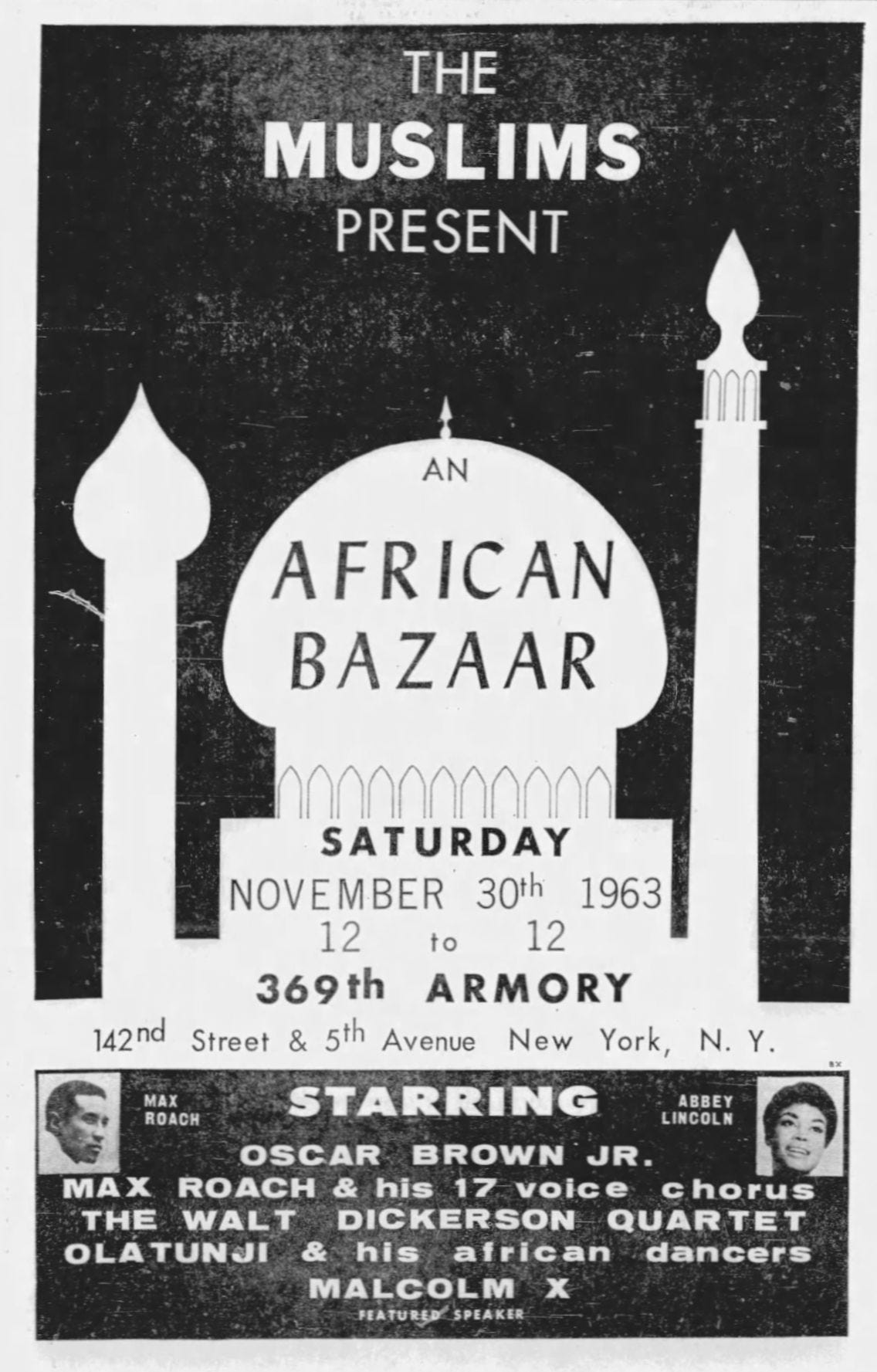
From a material standpoint, Lincoln and Roach performed the work at numerous benefits, for organizations that had diverging strategies. Its January 1961 world premiere was a CORE event. A Philadelphia performance for the NAACP’s Annual Convention the following summer sparked discussions of an ultimately unrealized tour sponsored by the organization. On November 30, 1963, Roach, Lincoln, Brown, Babatunde Olatunji, and a choir were booked to perform the suite at a Nation of Islam “African Bazaar” fair in Harlem. The featured speaker was Malcolm X, who was to make, just a day later, the comment about John F. Kennedy’s death that would set in motion the chain of events concluded by his own assassination.
After the summer 1964 murders of three civil rights workers by the Mississippi Ku Klux Klan, another CORE benefit featured the suite. In September, the Nation of Islam, by then in open conflict with Malcolm X, rented New York’s Town Hall to present a “concert of Modern music.” Freedom Now Suite was to be the main attraction. In February 1965, the suite was scheduled to receive its Boston premiere at a SNCC event. Malcolm X was shot two days later. Roach and Lincoln would appear at a benefit for his widow, Betty Shabazz, and at memorial programs later on. The suite was also performed in a variety of more classic commercial jazz settings, such as at Japanese and European concert dates, at the Newport Jazz Festival, at club and college gigs. In 1969, Roach and Lincoln were featured at the Shiraz-Persepolis Festival of Arts in Iran.
Freedom Now Suite eventually shook the need for the presence of its creators. It was featured on television programs, used as a basis for a compilation film shown at Dakar’s 1966 First World Festival of Negro Arts, it was said to have been banned by the South African state. More than six decades later, Freedom Now Suite has clearly obtained Duncombe’s ultimate recognition marker: a “place within ‘the tradition.’” Within the specific tradition of “political” music, it ranks particularly high. The work’s strong artistic qualities, formal innovations, wide influence, and its extensive track record “on the ground” without a doubt make that position warranted. But does this mean that everything about its intended or concrete political role was, or has since then been, clearly delineated? No. Clarity of intent and demonstrable effectiveness are only tenuously connected to the recognition a work of political art can receive. “At least I said something,” Roach wrote. Exactly what is not the point.